Leadership Competencies

APEX Leadership Competencies

The APEX program seeks to develop learners in the competencies of classical ethos, pathos, and logos, community leadership, people leadership, instructional leadership, self-awareness, leadership planning and execution, and experience. Learn more about each competency and our associated course offerings.
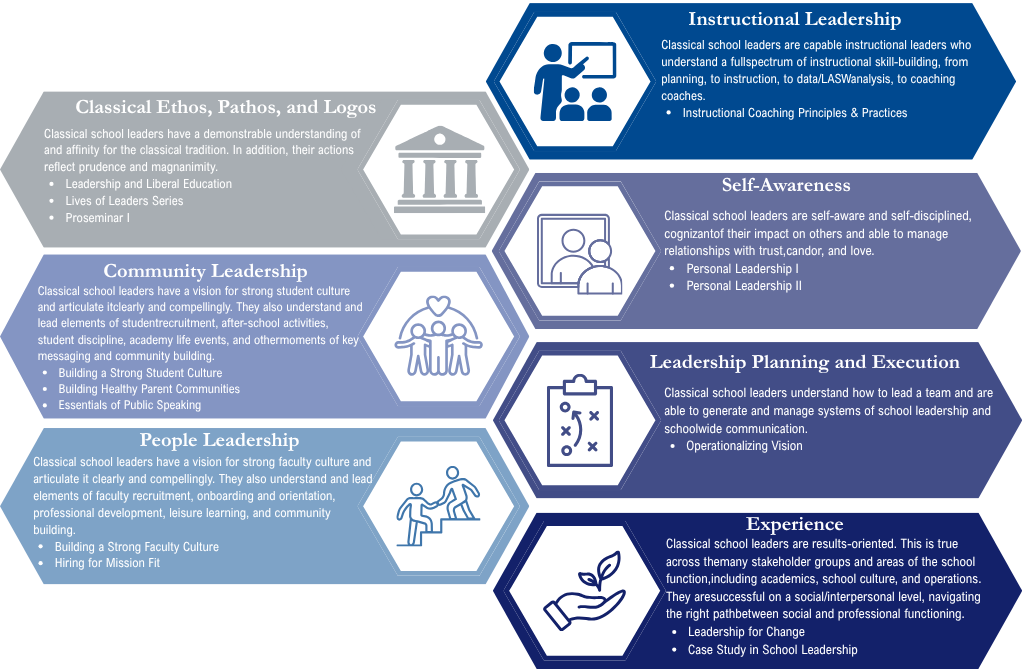
A diagram of an arrow pointing to the right, segmented into the seven leadership competencies: classical ethos, pathos, and logos, community leadership, people leadership, instructional leadership, self-awareness, leadership planning and execution, and experience. Under the arrow is a list of courses by competency.

APEX Courses, Organized by Competency

CompetencyDescriptionCourses
Classical Ethos, Pathos, and LogosClassical school leaders have a demonstrable understanding of and affinity for the classical tradition. In addition, their actions reflect prudence and magnanimity.Leadership & Liberal Education

Lives of Leaders: Thomas More

Lives of Leaders: Dr. Martin Luther King, Jr.

Lives of Leaders: Xenophon

Lives of Leaders: Abraham Lincoln

Community LeadershipClassical school leaders have a vision for strong student culture and articulate it clearly and compellingly. They also understand and lead elements of student recruitment, after-school activities, student discipline, academy life events, and other moments of key messaging and community building.Building a Strong Student Culture

Building Healthy Parent Communities

Essentials of Public Speaking

People LeadershipClassical school leaders have a vision for strong faculty culture and articulate it clearly and compellingly. They also understand and lead elements of faculty recruitment, onboarding and orientation, professional development, leisure learning, and community building.Building a Strong Faculty Culture

Hiring for Mission Fit

Essentials of Public Speaking

Instructional LeadershipClassical school leaders are capable instructional leaders who understand a full spectrum of instructional skill-building, from planning, to instruction, to data/LASW analysis, to coaching coaches.Instructional Coaching Principles & Practices
Self-AwarenessClassical school leaders are self-aware and self-disciplined, cognizant of their impact on others and able to manage relationships with trust, candor, and love.Personal Leadership I

Personal Leadership II

Leadership Planning and ExecutionClassical school leaders understand how to lead a team and are able to generate and manage systems of school leadership and schoolwide communication.Operationalizing Vision
ExperienceClassical school leaders are results-oriented. This is true across many stakeholder groups and areas of the school function, including academics, school culture, and operations. They are successful on a social/interpersonal level, navigating the right path between social and professional functioning.Leadership for Change: Understanding Change, Managing Transitions

Case Study in School Leadership